
4 min read
Is 240 GSM Too Heavy for Indian Weather?
Heavyweight or lightweight, answered honestly for Indian conditions. Why weight matters less than fibre, structure and cut — and the months when a 240 GSM tee genuinely is too much.

This is the question that stops most people buying a heavyweight t-shirt in India, and it deserves a straight answer rather than a sales one. A 240 GSM tee is not the right buy for everybody, and it is not the right buy for every month of the year.
The short answer
For most of the country, a 240 GSM cotton tee is comfortable from roughly October to March, workable through the monsoon, and genuinely warm in a dry 40°C May in Delhi or Ahmedabad. If you live somewhere that is hot and humid year round — Chennai, Kochi, coastal Mumbai — it is a good t-shirt for eight months and an ambitious one for four.
That is the honest version. What follows is why, because the weight on the label is only part of it.
Weight is not the same as warmth
Fabric does not heat you. Trapped air and trapped moisture heat you. Weight matters only insofar as it changes those two things, and it changes them less than people assume.
Three factors do more work than GSM:
- Fibre. 100% cotton moves moisture away from the skin and keeps moving it. A polyester blend at half the weight will feel hotter and smell worse by the afternoon, because the fibre itself does not absorb anything.
- Structure. A flat jersey packs its yarn tight. French terry knits loops on the inside, and those loops hold air and lift the cloth slightly off the skin. Two fabrics at an identical 240 GSM can behave completely differently for this reason alone.
- Contact area. Heat transfers where cloth touches skin. A slim 160 GSM tee is in contact with most of your torso; an oversized 240 GSM tee touches your shoulders and very little else.
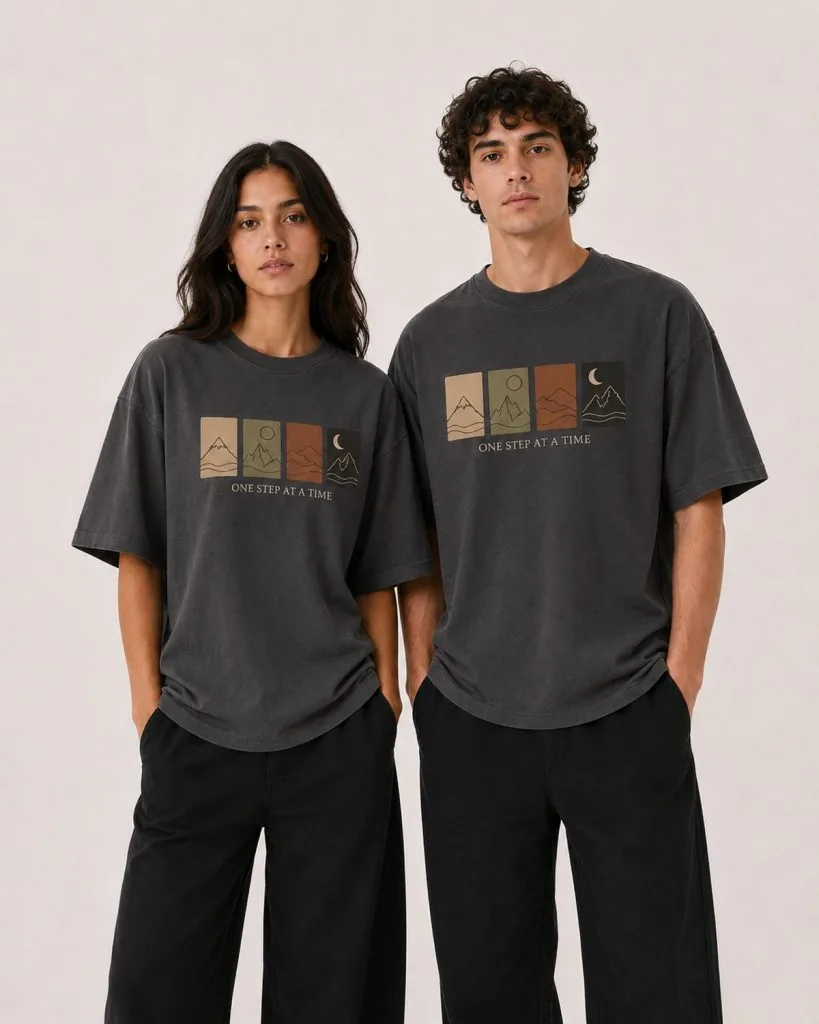
That last one is the reason a heavy oversized tee is not the contradiction it sounds like. The cut gives back much of what the weight costs.
Where lightweight genuinely wins
It would be dishonest to pretend otherwise. Reach for something lighter when you are outdoors in direct sun for hours, when you are moving hard enough to sweat through anything, or in peak humidity when nothing dries and the extra cloth simply stays wet longer.
Heavy cotton also takes longer to dry after a wash — a real consideration in a monsoon month with no sun and no dryer.
Where the weight earns its place
Air conditioning, which most people underestimate. An office at 22°C for nine hours is not a hot environment, and a thin tee is genuinely cold in one.
Evenings, most of the year, across most of the north. Travel, where one substantial tee replaces a thin tee plus a layer. And the whole of winter anywhere above Bangalore, where a 240 GSM tee works alone in the afternoon and under a jacket at night.
Then there is the part that has nothing to do with temperature: a heavy tee holds its shape, stays opaque, keeps its collar, and looks deliberate rather than worn out. A thin one thins until it is finished.
If you run hot
Buy the lighter colours. A sand or ecru tee in direct sun is measurably cooler than a navy or charcoal one, and the difference is larger than the difference between 180 and 240 GSM.
Take the size that fits properly rather than sizing up further — more cloth is more cloth. And wash it cold and dry it in shade, which keeps the terry loops open; a fabric that has been tumbled flat traps more heat than one that has not.
So: heavyweight or lightweight?
If you own two t-shirts, one of them should be light. If you are buying a t-shirt to keep for years rather than a season, weight is what makes that possible — and in an oversized cut, in cotton, in most of India, for most of the year, it costs you less comfort than the number suggests.
What it does not do is disappear in a Chennai May. No fabric does.
The GSM scale is explained here if you want the numbers behind all of this, and every piece in the collection is 240 GSM French terry in 100% cotton.